Sativa, Indica, Hybrid: Why Descriptions of the Same Strain Differ
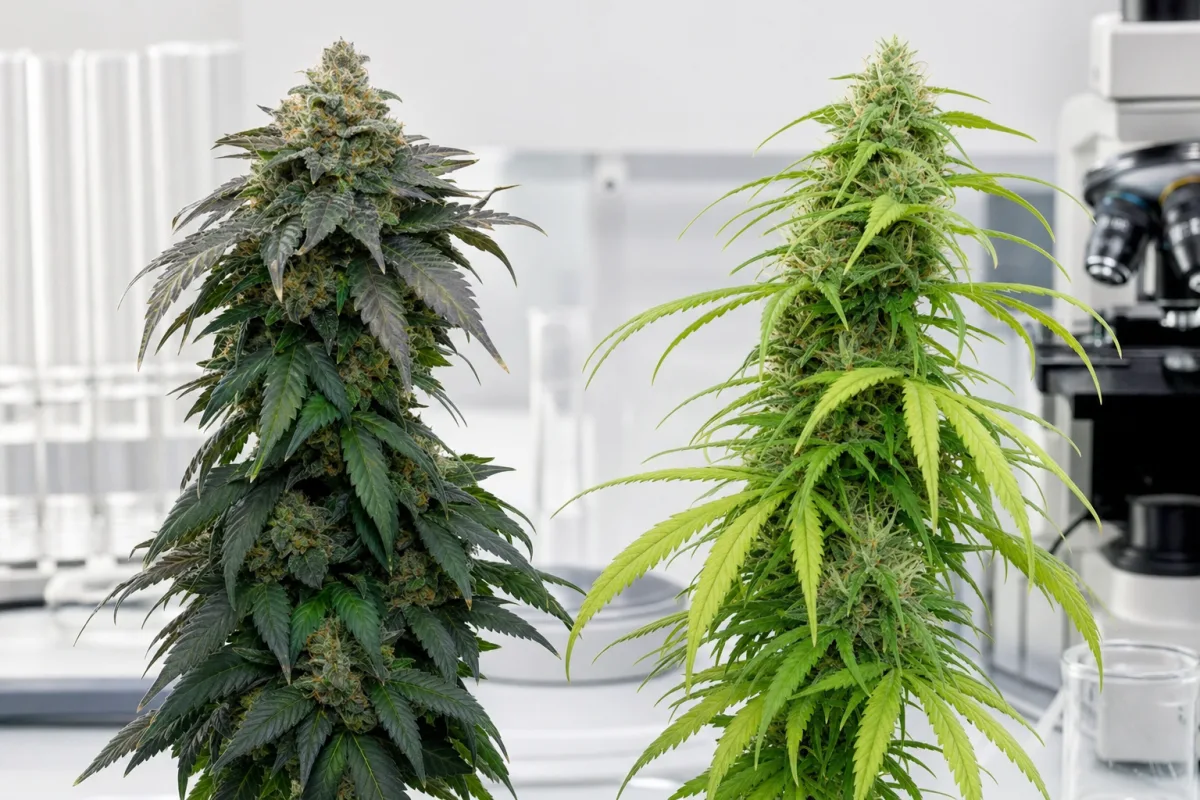
On a pharmacy product page a strain comes with a label: sativa, indica or hybrid. Compare a few sources and it quickly becomes clear that the same strain can carry different labels. This is not a mistake in one place but a feature of how such descriptions are produced.
Below are the numbers from our product overview (147 entries, as of 19.10.2026) and one study that explains why the labels deserve cautious trust. We do not describe how strains work here: the text is solely about how to read descriptions.
What labels we see in pharmacies
In the overview we find six description variants:
| Label | Number of entries |
|---|---|
| indica | 37 |
| indica-hybrid | 26 |
| sativa-hybrid | 22 |
| hybrid | 20 |
| sativa | 18 |
| no type given | 24 |
This means that every sixth entry (24 of 147) has no label at all, because the pharmacy page does not give one, and we do not fill in data from guesswork.
Where the label comes from
For the 123 entries with a given type, the source breaks down like this: 97 times it is the pharmacy page (a product description coming from the producer or distributor), 21 times a publicly available strain database, and only 5 times the producer itself.
This matters, because the label on a pharmacy page need not be the one the producer put in the leaflet. These are two different documents, created at different times and by different people.
The same strain, two labels
In the overview we have three Aurora strains for which pharmacies and the producer's leaflet say different things:
| Strain | Pharmacy pages | Producer's leaflet |
|---|---|---|
| Electric Honeydew | hybrid | Sativa (at THC 27%) |
| Black Jelly | hybrid/sativa | Sativa |
| Farm Gas | hybrid/indica | Indica |
We do not decide which version is "true". We show that within a single chain (producer, distributor, pharmacy) a label is sometimes copied and shortened. That is why for each entry in the overview we give the source of the type.
What the genetic study says
In 2015, Jason Sawler's team published an analysis in PLoS ONE of 14,031 genetic markers (SNPs) in 81 marijuana samples and 43 hemp samples. The authors write that marijuana strain names often do not reflect meaningful genetic identity, and that the agreement between genetic structure and the declared sativa/indica origin is only moderate.
This is a single study from more than a decade ago, so it does not settle the matter once and for all. It does, however, show why the sativa/indica split alone is not a good key for comparing products.
How to use this
Frequently asked questions
Why do 24 entries have no type?
Because neither the pharmacy page nor the producer's leaflet gives one. We prefer to leave the field empty rather than enter a type from a guess.
Which label is the right one when sources differ?
We do not decide that. We give both and point to the source, and the final point of reference for the patient is the leaflet of the specific package.
Does the type tell you how a product will work?
This text does not describe or assess that. If you want to discuss it, do so with your treating doctor.
Sources
This text is informational: it collects publicly available data from producers, distributors and pharmacies. It does not describe effects or indications, is not an advertisement or a recommendation, and the choice of product and dosage is always decided by the doctor.
Ready to start therapy?
Book online in 60 seconds - consultation at our clinic in Krakow, Bydgoszcz, Toruń or Kielce.
Book a consultation